The Lookout · Economy
Scientists Just Made Gold in a Lab. Should Gold Owners Be Worried?
Scientists can make real gold in a laboratory. And now a company called Marathon Fusion says it has taken another important step toward turning mercury into stable gold.
Could lab-made gold eventually flood the market? Could it cause gold prices to collapse? And if you already own physical gold — or are considering buying some — should you be concerned?
The science is fascinating. But there's an enormous difference between producing gold in a laboratory and manufacturing enough gold economically to change the global market. The numbers tell a surprisingly reassuring story.
The Dream of Making Gold Is Centuries Old
For hundreds of years, alchemists searched for ways to turn ordinary metals into gold. They experimented with lead, mercury, chemicals, heat, and countless other methods.
Their dream was simple: transform something relatively common into something extraordinarily valuable.
But gold is a chemical element. Ordinary chemical reactions cannot change lead or mercury into gold. That requires changing the structure of an atom's nucleus, something modern nuclear physics has made possible.
Scientists call this nuclear transmutation.
Researchers have demonstrated this process, and recent developments suggest it could eventually have new practical applications.
But there's an important distinction.
Making gold and making gold economically are two completely different achievements.
Scientists Have Already Turned Lead Into Gold
In May 2025, CERN, the European nuclear research organization, reported that experiments at the Large Hadron Collider had transformed lead nuclei into gold nuclei.
It was a remarkable scientific accomplishment.
How much gold did they produce?
Approximately 29 trillionths of a gram during the collider's 2015–2018 operating period.
And the gold nuclei existed for only a tiny fraction of a second before being destroyed.
To put that into perspective, the quantity was far too small to make even an ordinary piece of gold jewelry.
Scientists had demonstrated that nuclear transmutation worked. But producing tiny quantities of gold through nuclear reactions is very different from operating a gold-producing business.
Now a Company Says It Has Made Another Breakthrough
In October 2026, a San Francisco technology company called Marathon Fusion announced that it had converted mercury into genuine, stable gold using fusion neutrons.
Its proposed approach is different from CERN's.
Instead of creating fleeting gold nuclei from lead, the process uses high-energy neutrons to transform a particular form of mercury into another form that eventually becomes stable gold.
Stable gold-197 is the same type of gold atom found in ordinary gold bullion.
But there are important qualifications.
Marathon Fusion has not publicly disclosed a verified commercial production quantity, and its latest experimental claim has not yet been independently confirmed.
The company has also not demonstrated that its process can manufacture gold profitably on a commercial scale.
Its longer-term idea is to produce gold alongside electricity from nuclear fusion, the process that powers the sun.
That is an intriguing possibility. But an experimental achievement and a commercially operating gold-production facility are very different things.
Here's Where the Numbers Get Interesting
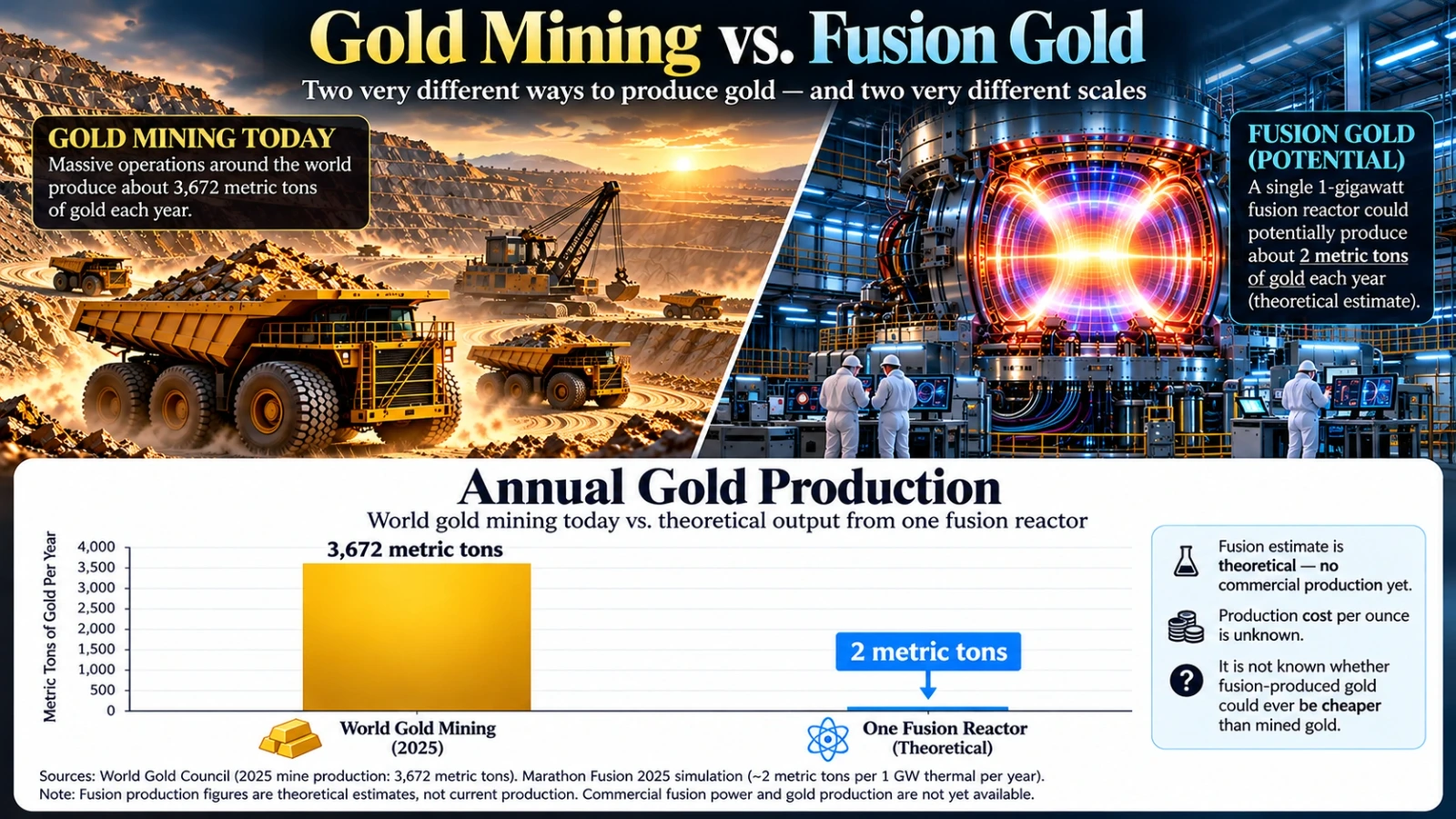
According to the World Gold Council, mines around the world produced approximately 3,672 metric tons of gold in 2025.
Now compare that with Marathon Fusion's proposed technology.
Its researchers published a model estimating that a future fusion reactor producing one gigawatt of thermal power could theoretically manufacture approximately 2 metric tons of gold annually.
The comparison is remarkable.
- Worldwide gold mining in 2025: 3,672 metric tons
- One proposed fusion reactor: 2 metric tons annually
That's a difference of approximately 1,836 to 1.
Even if the fusion process worked exactly as modeled, one such reactor would produce only about 0.054% of today's annual worldwide mine production.
The 2-metric-ton figure comes from a computer simulation. It represents potential production from a proposed reactor design, rather than actual commercial gold production.
The comparison illustrates just how much gold the world currently mines compared with the proposed output of one fusion reactor.
Of course, multiple reactors could increase total production. But that would require building and operating an entirely new industry.
And there's another question that may be even more important.
What Would It Actually Cost to Manufacture Gold?
This may be the biggest unanswered question of all.
Mining companies have decades of operating experience. Their financial statements provide information about the costs of finding, extracting, and processing gold.
Fusion-produced gold would involve an entirely different process.
It would require sophisticated nuclear equipment, specially prepared mercury, and systems for recovering the resulting gold safely.
There would also be expenses associated with construction, maintenance, processing, and handling radioactive materials.
Marathon Fusion proposes that producing gold alongside electricity could help make fusion plants more financially attractive.
That is an interesting business model.
But no one has demonstrated a reliable commercial cost per ounce for fusion-produced gold.
We don't yet know whether manufacturing gold through nuclear fusion could compete economically with mining.
And that's crucial.
A process that costs substantially more to manufacture an ounce of gold than the gold is worth would face an obvious economic obstacle.
Until those economics are demonstrated, predictions of unlimited cheap gold are premature.
Could Manufactured Gold Eventually Cause Gold Prices to Fall?
Potentially, yes.
If technology someday allows companies to manufacture substantial quantities of gold inexpensively, that could increase supply and put downward pressure on prices.
But there are significant obstacles between today's experiments and that possibility.
Fusion power itself is still moving toward commercial viability. Manufacturing gold at scale would require additional engineering, specialized materials, and practical methods for recovering the finished metal.
There's another important consideration.
Gold is unusually durable. Unlike oil or natural gas, which are consumed, much of the gold mined throughout history still exists.
That means newly produced gold enters an enormous existing stock.
Gold prices also respond to investor demand, central-bank buying, interest rates, currency movements, and broader economic conditions.
New production technology could eventually become another factor influencing prices.
Its impact would depend on how much additional gold it actually supplied and how quickly that supply increased.
When Could Lab-Made Gold Become Commercially Available?
Nobody knows.
Fusion-energy developers are working toward commercial power generation, with some ambitious projects targeting the 2030s.
But achieving commercially viable fusion electricity generation would be only one step toward commercial gold production.
Companies would still need to demonstrate that the gold-production process works reliably, can be scaled, and makes economic sense.
Widespread adoption could take many years beyond the first successful commercial fusion plants.
It is also possible that costs or engineering challenges will prevent the process from becoming commercially competitive.
For now, commercially operating fusion plants are not producing significant quantities of gold for the bullion market.
So, Should Gold Owners Be Worried?
There's no reason to panic over this announcement.
Scientists have been pursuing the dream of manufacturing gold for centuries.
Modern physics has made nuclear transmutation possible, and the latest research may represent another step forward.
But the recent announcement does not change the amount of gold currently available in the market.
It does not demonstrate an economical method of large-scale production.
And it does not establish that gold's scarcity is about to disappear.
Could future technology change the economics of gold production?
Absolutely. That possibility deserves attention.
But an emerging scientific capability should be evaluated based on what it has actually demonstrated.
For people who own gold as part of a long-term wealth-preservation strategy, this is a development worth following — not a headline that demands an immediate investment decision.
Frequently Asked Questions
Can scientists actually make real gold?
Yes. Nuclear transmutation can convert certain elements into genuine gold by changing their atomic nuclei. Scientists have demonstrated this on a tiny scale, but economical commercial-scale manufacturing remains unproven.
Can scientists turn lead or mercury into gold?
CERN has demonstrated the transformation of lead nuclei into extremely small amounts of short-lived gold nuclei. Marathon Fusion has recently claimed to produce stable gold from mercury, although its latest experimental results have not yet been independently verified.
Will manufactured gold cause gold prices to crash?
There is currently no evidence of an immediate threat. Its future effect would depend on manufacturing costs, commercial scalability, the amount of additional gold produced, and market demand.
Is physical gold still scarce?
Yes. Despite advances in nuclear physics, gold remains a relatively scarce physical resource. Today's commercially available gold supply still comes primarily from mining and recycling.
The Bottom Line
Perhaps the most useful way to understand this story is to separate three questions.
Can scientists make real gold?
Yes. That has already been demonstrated.
Can they manufacture large quantities of gold?
Researchers have developed theoretical methods, but commercial-scale production has not been demonstrated.
Can they produce gold cheaply enough to compete with mining?
Nobody has demonstrated that yet.
And that is the important distinction missing from many of today's headlines.
For centuries, people dreamed of turning ordinary metals into gold.
Science has made that dream possible on a tiny scale.
But there is still an enormous distance between making gold in a laboratory and producing enough affordable gold to significantly alter the global market.
For now, gold owners can follow this fascinating development with curiosity rather than alarm.
Sources & Further Reading
- CERN — ALICE Detects the Conversion of Lead Into Gold at the LHC: https://home.cern/news/news/physics/alice-detects-conversion-lead-gold-lhc
- Marathon Fusion Researchers — Scalable Chrysopoeia via Fusion Neutrons: https://arxiv.org/abs/2507.13461
- World Gold Council — Gold Demand Trends, Full Year 2025, Supply: https://www.gold.org/goldhub/research/gold-demand-trends/gold-demand-trends-full-year-2025/supply